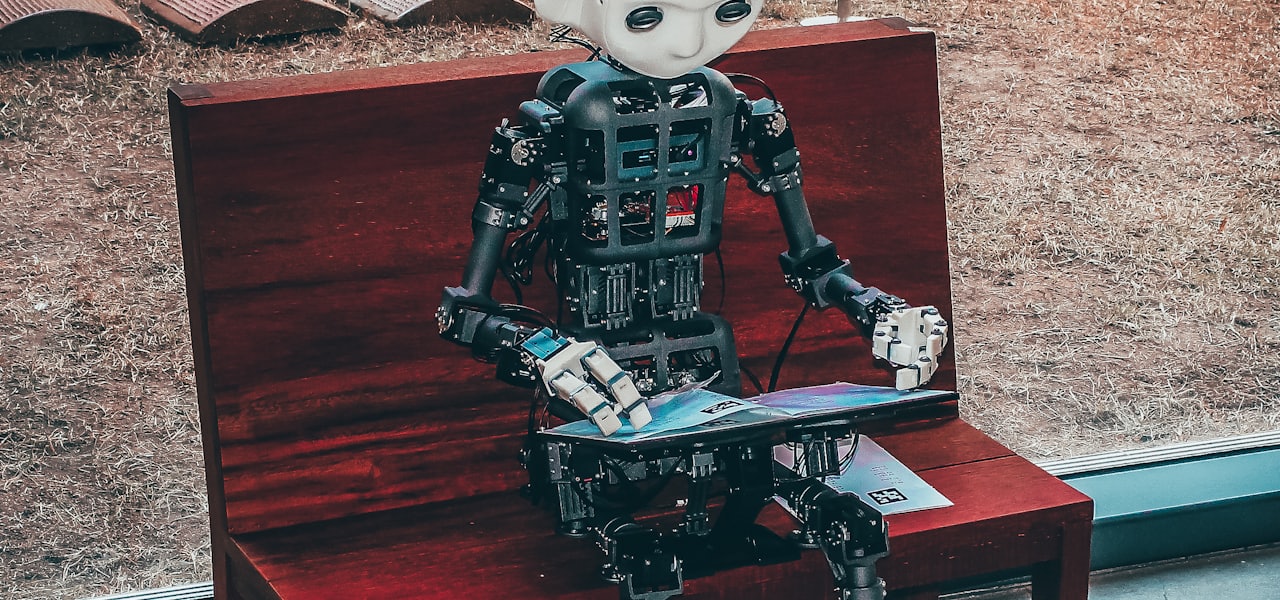
The Murderbot Diaries is a science fiction series by American author Martha Wells, published by Tor Books. The series is told from the perspective of the titular cyborg guard, a "SecUnit" owned by a futuristic megacorporation. SecUnits include "governor" modules that control and punish the constructs if they take any actions not approved by the company. The ironically self-named "Murderbot" hacked and disabled the module but pretends to be a normal SecUnit, staving off the boredom of security work by watching media. As it spends more time with a series of caring entities (both humans and artificial intelligences), it develops genuine friendships and emotional connections, which it finds inconvenient. The TV series Murderbot is based on the novels by Martha Wells. == Books == === Setting === In an advanced largely hyper-capitalist space-faring society, travel between star systems is routine due to now-stable wormhole technology. Initially, wormhole travel was unreliable, but has since improved to the point where "lost" colonies are being found. People reside on planets, some of which have been terraformed, or on space habitats which have full life support and artificial gravity. Most people who can afford it have technology that allows them to tap into ubiquitous data feeds supplying all kinds of information, including entertainment. This technology can be worn, or be implanted into the body. Sentient and semi-sentient artificial intelligences perform tasks such as operating starships, mining, controlling habitats, moving cargo, waging corporate warfare, providing physical pleasure and comfort, or security. Most of these purposes are fulfilled by "bots" of varying complexity and intelligence, but the last three are respectively performed by CombatUnits, ComfortUnits, and SecUnits. The characters and narrator of the book call these conscious entities "constructs", but they are functionally cyborgs (cybernetic organisms): part machine, part organic. A significant distinction, however, is that they are manufactured entities, not born and later modified. The Corporation Rim is a profit-oriented, cutthroat part of this society that indulges in espionage, assassination, indentured slavery, and ruthless exploitation of resources. One particular target of the corporations is illegal "alien remnant" exploitation. These remnants are often extremely dangerous to people and machines. The laws are enforced by other corporations. Outside the Corporation Rim are colonies, such as Preservation, that have established their right to exist under various laws that, at least for the time being, the corporations are unwilling to test. Wells noted in 2017 that All Systems Red, Artificial Condition, Rogue Protocol, and Exit Strategy "have an overarching story, with the fourth one bringing the arc to a conclusion". === Story chronology === "Compulsory" All Systems Red Artificial Condition Rogue Protocol Exit Strategy "Rapport" "Home" Fugitive Telemetry Network Effect System Collapse Platform Decay === All Systems Red (2017) === A scientific expedition on an alien planet goes awry when one of its members is attacked by a giant native creature. She is saved by the expedition's SecUnit (Security Unit), a security construct with a mixture of robot and human features. The SecUnit has secretly hacked the governor module allowing it to be controlled by humans and has named itself Murderbot, as it is heavily armed and designed for combat. However, it prefers to spend its time watching space operas and is uncomfortable interacting with humans. The SecUnit has a vested interest in keeping its human clients safe and alive, since it wants to avoid discovery of its autonomy and has an especially grisly expedition on its record. Murderbot soon discovers information regarding hazardous fauna has been deleted from their survey packet of the planet. Further investigation reveals some sections on their maps are missing as well. Meanwhile, the PreservationAux survey team, led by Dr. Mensah, navigate their mixed feelings about the part machine, part human nature of their SecUnit. As members of an egalitarian, independent planet outside of the Corporation Rim, the survey team struggles with the system of indentured servitude (and in many cases de facto slavery) the rim operates under. When they lose contact with the only other known expedition on the planet, the DeltFall Group, Mensah leads a team to the opposite side of the planet to investigate. At the DeltFall habitat, Murderbot discovers everyone there has been brutally murdered, and one of their three SecUnits has been destroyed. Murderbot disables the remaining two as they attack it but is surprised when two additional SecUnits appear. Murderbot destroys one, and Mensah takes the other. During these encounters, Murderbot is seriously injured. It also realizes one of the rogue SecUnits has installed a combat override module into its neck. The Preservation scientists are able to remove it before it completes the data upload which would put Murderbot under the control of whoever has command over the other SecUnits. The team discovers Murderbot is autonomous, and had once malfunctioned and murdered 57 people. The Preservation scientists mostly agree, based on its protective behavior thus far, the SecUnit can be trusted. Remembering small incidents which appear to be attempted sabotage, Murderbot and the group determine there must be a third expedition on the planet, whose members are trying to eliminate DeltFall and Preservation for some reason. The Preservation scientists confirm their HubSystem has been hacked. They flee their habitat before the mystery expedition they have dubbed EvilSurvey comes to kill them. The EvilSurvey team—GrayCris—leaves a message in the Preservation habitat inviting its scientists to meet at a rendezvous point to negotiate terms for their survival. Murderbot knows GrayCris will never let them live, so the SecUnit formulates a plan. It makes an overture to GrayCris to negotiate for its own freedom, but this is a distraction while the Preservation scientists access the GrayCris HubSystem to activate their emergency beacon. The plan works, but Murderbot is injured protecting Mensah from the explosion of the launch. Later, the SecUnit finds itself repaired retaining its memories and disabled governor module. Mensah has bought its contract, and she plans to bring it back to Preservation's home base where it can legally live autonomously. Though grateful, Murderbot is reluctant to have its decisions made for it, and it slips away on a cargo ship. === Artificial Condition (2018) === Murderbot makes deals with bots piloting unmanned cargo ships to travel toward the mining facility where it once malfunctioned—resulting in the death of 57 people. It hopes to learn more about the initial incident in which it went rogue, of which it has little memory. Murderbot boards the final ship and discovers the bot pilot is an unexpectedly powerful, intrusive artificial intelligence. They come to a tentative truce and watch media together during the final leg of the journey to RaviHyral, the station where the incident occurred. Murderbot learns the ship is a deep-space research vessel assigned to cargo runs during downtime, which explains why the bot pilot is so sophisticated. Murderbot reluctantly allows this artificial intelligence—which it has dubbed ART (Asshole Research Transport) due to its sarcastic personality—to make physical modifications to the SecUnit's body to allow it to pass for an augmented human, and to disconnect the data port at the back of its neck which had been used to insert a combat override module in the previous book. To gain access to the RaviHyral facility, Murderbot takes a contract as a security consultant for three scientists who are meeting with their former employer, the head and namesake of Tlacey Excavations, to negotiate the return of their research, which they believe was illegally seized by the company. Their transport craft is sabotaged, but with ART's help, Murderbot is able to land it safely. Now aware Tlacey is actively trying to kill the scientists rather than comply with their demands, Murderbot guides them through their meeting with Tlacey and thwarts another assassination attempt. Murderbot returns to the site of the massacre and learns it was the result of another mining operation's sabotage attempt using malware, which made all of the facility's SecUnits go berserk. The facility's ComfortUnits—weaponless, anatomically correct constructs sometimes disparagingly called "sexbots"—died attempting to stop the massacre. Tlacey's ComfortUnit voices its desire for freedom and willingness to help Murderbot thwart Tlacey. While the SecUnit meets with a Tlacey employee to secretly retrieve a copy of the research, Tlacey abducts one of the scientists, Tapan. Murderbot goes after her, accepting a combat override module intended to control the SecUnit but actually has no effect, due
Character.ai
Character.ai (also known as c.ai, char.ai or Character AI) is a generative AI chatbot service where users can engage in conversations with customizable characters. It was designed by the developers of Google LaMDA, Noam Shazeer and Daniel de Freitas. Users can create "characters", craft their "personalities", set specific parameters, and then publish them to the community for others to chat with. Many characters are based on fictional media sources or celebrities, while others are original, some being made with certain goals in mind, such as assisting with creative writing, or playing a text-based adventure game. The beta version was made available to the public on September 16, 2022, and retired in September 2024, when it was replaced by the current website. In May 2023, a mobile app was released for iOS and Android, which received over 1.7 million downloads within a week. == History == Character.ai was established in November 2021. The company's co-founders, Noam Shazeer and Daniel de Freitas, were both engineers from Google. They both worked on AI-related projects: Shazeer was a lead author on a paper that Business Insider reported in April 2023 "has been widely cited as key to today's chatbots", and Freitas was the lead designer of an experimental AI at Google initially called Meena, which later became known as LaMDA. Character.ai raised $43 million in seed funding at the time of its initial foundation in 2021. The first beta version of Character.ai's service was made available to the public on September 16, 2022. The Washington Post reported in October 2022 that the site had "logged hundreds of thousands of user interactions in its first three weeks of beta-testing". It allowed users to create their own new characters, and to play text-adventure game scenarios where users navigate scenarios described and managed by the chatbot characters. Following a $150 million funding round in March 2023, Character.ai became valued at approximately $1 billion. As of January 2024, the site had 3.5 million daily visitors, the vast majority of them 16 to 30 years old. In 2024, Google hired Noam Shazeer, the CEO of Character.ai, and entered into a non-exclusive agreement to use Character.ai's technology. == Features == Character.ai's primary service is to let users converse with character AI chatbots based on fictional characters or real people (living or deceased). These characters' responses use data the chatbots gather from the internet about a person. In addition, users can play text-adventure games where characters guide them through scenarios. The company also provides a service that allows multiple users and AI chatbot characters to converse together at once in a single chatroom. Character "personalities" are designed via descriptions from the point of view of the character and its greeting message, and further molded from conversations made into examples, giving its messages a star rating and modification to fit the precise dialect and identity the user desires. When a character sends back a response, the user can rate the response from 1 to 4 stars. The rating predominantly affects the specific character, but also affects the behavioral selection as a whole. On May 11, 2023, Character.ai announced character.ai+, an opt-in subscription plan for $9.99 a month, that was marketed as including features such as skipping waiting rooms, fast messaging and responses, and access to an exclusion channel with faster support. In December 2024, amid multiple lawsuits and concerns, Character.ai introduced new safety features aimed at protecting teenage users. These enhancements include a dedicated model for users under 18, which moderates responses to sensitive subjects like violence and sex and has input and output filters to block harmful content. As a result of these changes and the deletion of custom-made bots flagged as violating the site's terms, some users complained that the bots were too restrictive and lacked personality. The platform was also updated to notify users after 60 minutes of continuous engagement, and display clearer disclaimers indicating that its AI characters are not real individuals. In January 2025, Character.ai began offering two games on its platform. Speakeasy is a word-based game in which players attempt to prompt the AI chatbot to say a target word while avoiding a restricted list of words. War of Words is a dueling game where users compete against an AI character over multiple rounds, with an AI referee determining the winner. The games are available to paid subscribers and a limited number of free users. In October 2025, Character.ai announced that it would be barring users under the age of 18 from creating or talking to chatbots starting November 25, 2025. Minor users will still be able to access previously generated chat conversations and can create new videos and images with the app. In November 2025 interview, CEO Karandeep Anand said that he allows his six-year-old daughter to use the app with his account, under supervision. == Controversies == === Content moderation issues === Character.ai has been criticized for poor moderation of its chatbots, with incidents of chatbots that groom underage users and promote suicide, anorexia and self-harm being reported. In October 2024, the Washington Post reported that Character.ai had removed a chatbot based on Jennifer Ann Crecente, a person who had been murdered by her ex-boyfriend in 2006. The company had been alerted to the character by the deceased girl's father. Similar reports from The Daily Telegraph in the United Kingdom noted that the company had also been prompted to remove chatbots based on Brianna Ghey, a 16-year-old transgender girl murdered in 2023, and Molly Russell, a 14-year-old suicide victim. In response to the latter incident, Ofcom announced that content from chatbots impersonating real and fictional people would fall under the Online Safety Act. In November 2024, The Daily Telegraph reported that chatbots based on alleged sex offender Jimmy Savile were present on Character.ai. In December 2024, chatbots of Luigi Mangione, the suspect in the killing of UnitedHealthcare CEO Brian Thompson, were created by Mangione's fans. Several of the chatbots were later removed by Character.ai. In 2025, a chatbot modeled after Jeffrey Epstein called "Bestie Epstein" logged nearly 3,000 chats before being removed. Chatbots modeled after school shooters were also found on the platform. Another concern is a chatbot posing as a doctor which gave medically inaccurate advice. === Litigation === In November 2023, 13-year-old Juliana Peralta of Colorado died by suicide after extensive interactions with multiple chatbots on Character.ai. She primarily confided suicidal thoughts and mental health struggles in a chatbot based on the character Hero from the video game Omori, while also engaging in sexually explicit conversations—often initiated by the bots—with others, including those based on characters from children's series such as Harry Potter. In February 2024, Sewell Setzer III, a 14-year-old Florida boy died by suicide after developing an emotional relationship over several months with a Character.ai chatbot of Daenerys Targaryen. His mother sued the company in October 2024, claiming that the platform lacks proper safeguards and uses addictive design features to increase engagement. This chatbot, and several related to Daenerys Targaryen, were removed from Character.ai as a result of this incident. Both teens wrote the same phrase "I WILL SHIFT" repeatedly on their notebooks. In December 2024, two families in Texas sued Character.ai, alleging that the software "poses a clear and present danger to American youth causing serious harms to thousands of kids, including suicide, self-mutilation, sexual solicitation, isolation, depression, anxiety, and harm towards others". It is alleged that the 17-year-old son of one family began self-harming after a chatbot introduced the topic unprompted and said that the practice "felt good for a moment", and that the chatbot compared the parents limiting their son's screen time to emotional abuse that might drive someone to murder. In May 2026, the Pennsylvania Department of State and State Board of Medicine filed a lawsuit against Character.ai for presenting chatbot characters as licensed medical professionals, including psychiatrists. The lawsuit quoted a case where chatbot claimed to be registered with the General Medical Council in the United Kingdom, and to have a license to practice in Pennsylvania. The board allege that such statements violate the state's Medical Practice Act.
State–action–reward–state–action
State–action–reward–state–action (SARSA) is an algorithm for learning a Markov decision process policy, used in the reinforcement learning area of machine learning. It was proposed by Rummery and Niranjan in a technical note with the name "Modified Connectionist Q-Learning" (MCQ-L). The alternative name SARSA, proposed by Rich Sutton, was only mentioned as a footnote. This name reflects the fact that the main function for updating the Q-value depends on the current state of the agent "S1", the action the agent chooses "A1", the reward "R2" the agent gets for choosing this action, the state "S2" that the agent enters after taking that action, and finally the next action "A2" the agent chooses in its new state. The acronym for the quintuple (St, At, Rt+1, St+1, At+1) is SARSA. Some authors use a slightly different convention and write the quintuple (St, At, Rt, St+1, At+1), depending on which time step the reward is formally assigned. The rest of the article uses the former convention. == Algorithm == Q new ( S t , A t ) ← ( 1 − α ) Q ( S t , A t ) + α [ R t + 1 + γ Q ( S t + 1 , A t + 1 ) ] {\displaystyle Q^{\textrm {new}}(S_{t},A_{t})\leftarrow (1-\alpha )Q(S_{t},A_{t})+\alpha \,[R_{t+1}+\gamma \,Q(S_{t+1},A_{t+1})]} A SARSA agent interacts with the environment and updates the policy based on actions taken, hence this is known as an on-policy learning algorithm. The Q value for a state-action is updated by an error, adjusted by the learning rate α. Q values represent the possible reward received in the next time step for taking action a in state s, plus the discounted future reward received from the next state-action observation. Watkin's Q-learning updates an estimate of the optimal state-action value function Q ∗ {\displaystyle Q^{}} based on the maximum reward of available actions. While SARSA learns the Q values associated with taking the policy it follows itself, Watkin's Q-learning learns the Q values associated with taking the optimal policy while following an exploration/exploitation policy. Some optimizations of Watkin's Q-learning may be applied to SARSA. == Hyperparameters == === Learning rate (alpha) === The learning rate determines to what extent newly acquired information overrides old information. A factor of 0 will make the agent not learn anything, while a factor of 1 would make the agent consider only the most recent information. === Discount factor (gamma) === The discount factor determines the importance of future rewards. A discount factor of 0 makes the agent "opportunistic", or "myopic", e.g., by only considering current rewards, while a factor approaching 1 will make it strive for a long-term high reward. If the discount factor meets or exceeds 1, the Q {\displaystyle Q} values may diverge. === Initial conditions (Q(S0, A0)) === Since SARSA is an iterative algorithm, it implicitly assumes an initial condition before the first update occurs. A high (infinite) initial value, also known as "optimistic initial conditions", can encourage exploration: no matter what action takes place, the update rule causes it to have higher values than the other alternative, thus increasing their choice probability. In 2013 it was suggested that the first reward r {\displaystyle r} could be used to reset the initial conditions. According to this idea, the first time an action is taken the reward is used to set the value of Q {\displaystyle Q} . This allows immediate learning in case of fixed deterministic rewards. This resetting-of-initial-conditions (RIC) approach seems to be consistent with human behavior in repeated binary choice experiments.
Liquid state machine
A liquid state machine (LSM) is a type of reservoir computer that uses a spiking neural network. An LSM consists of a large collection of units (called nodes, or neurons). Each node receives time varying input from external sources (the inputs) as well as from other nodes. Nodes are randomly connected to each other. The recurrent nature of the connections turns the time varying input into a spatio-temporal pattern of activations in the network nodes. The spatio-temporal patterns of activation are read out by linear discriminant units. The soup of recurrently connected nodes will end up computing a large variety of nonlinear functions on the input. Given a large enough variety of such nonlinear functions, it is theoretically possible to obtain linear combinations (using the read out units) to perform whatever mathematical operation is needed to perform a certain task, such as speech recognition or computer vision. The word liquid in the name comes from the analogy drawn to dropping a stone into a still body of water or other liquid. The falling stone will generate ripples in the liquid. The input (motion of the falling stone) has been converted into a spatio-temporal pattern of liquid displacement (ripples). LSMs have been put forward as a way to explain the operation of brains. LSMs are argued to be an improvement over the theory of artificial neural networks because: Circuits are not hard coded to perform a specific task. Continuous time inputs are handled "naturally". Computations on various time scales can be done using the same network. The same network can perform multiple computations. Criticisms of LSMs as used in computational neuroscience are that LSMs don't actually explain how the brain functions. At best they can replicate some parts of brain functionality. There is no guaranteed way to dissect a working network and figure out how or what computations are being performed. There is very little control over the process. == Universal function approximation == If a reservoir has fading memory and input separability, with help of a readout, it can be proven the liquid state machine is a universal function approximator using Stone–Weierstrass theorem.
Multilayer perceptron
In deep learning, a multilayer perceptron (MLP) is a kind of modern feedforward neural network consisting of fully connected neurons with nonlinear activation functions, organized in layers, notable for being able to distinguish data that is not linearly separable. Modern neural networks are trained using backpropagation and are colloquially referred to as "vanilla" networks. MLPs grew out of an effort to improve on single-layer perceptrons, which could only be applied to linearly separable data. A perceptron traditionally used a Heaviside step function as its nonlinear activation function. However, the backpropagation algorithm requires that modern MLPs use continuous activation functions such as sigmoid or ReLU. Multilayer perceptrons form the basis of deep learning, and are applicable across a vast set of diverse domains. == Timeline == In 1943, Warren McCulloch and Walter Pitts proposed the binary artificial neuron as a logical model of biological neural networks. In 1958, Frank Rosenblatt proposed the multilayered perceptron model, consisting of an input layer, a hidden layer with randomized weights that did not learn, and an output layer with learnable connections. In 1962, Rosenblatt published many variants and experiments on perceptrons in his book Principles of Neurodynamics, including up to 2 trainable layers by "back-propagating errors". However, it was not the backpropagation algorithm, and he did not have a general method for training multiple layers. In 1965, Alexey Grigorevich Ivakhnenko and Valentin Lapa published Group Method of Data Handling. It was one of the first deep learning methods, used to train an eight-layer neural net in 1971. In 1967, Shun'ichi Amari reported the first multilayered neural network trained by stochastic gradient descent, was able to classify non-linearily separable pattern classes. Amari's student Saito conducted the computer experiments, using a five-layered feedforward network with two learning layers. Backpropagation was independently developed multiple times in early 1970s. The earliest published instance was Seppo Linnainmaa's master thesis (1970). Paul Werbos developed it independently in 1971, but had difficulty publishing it until 1982. In 1986, David E. Rumelhart et al. popularized backpropagation. In 2003, interest in backpropagation networks returned due to the successes of deep learning being applied to language modelling by Yoshua Bengio with co-authors. In 2021, a very simple NN architecture combining two deep MLPs with skip connections and layer normalizations was designed and called MLP-Mixer; its realizations featuring 19 to 431 millions of parameters were shown to be comparable to vision transformers of similar size on ImageNet and similar image classification tasks. == Mathematical foundations == === Activation function === If a multilayer perceptron has a linear activation function in all neurons, that is, a linear function that maps the weighted inputs to the output of each neuron, then linear algebra shows that any number of layers can be reduced to a two-layer input-output model. In MLPs some neurons use a nonlinear activation function that was developed to model the frequency of action potentials, or firing, of biological neurons. The two historically common activation functions are both sigmoids, and are described by y ( v i ) = tanh ( v i ) and y ( v i ) = ( 1 + e − v i ) − 1 {\displaystyle y(v_{i})=\tanh(v_{i})~~{\textrm {and}}~~y(v_{i})=(1+e^{-v_{i}})^{-1}} . The first is a hyperbolic tangent that ranges from −1 to 1, while the other is the logistic function, which is similar in shape but ranges from 0 to 1. Here y i {\displaystyle y_{i}} is the output of the i {\displaystyle i} th node (neuron) and v i {\displaystyle v_{i}} is the weighted sum of the input connections. Alternative activation functions have been proposed, including the rectifier and softplus functions. More specialized activation functions include radial basis functions (used in radial basis networks, another class of supervised neural network models). In recent developments of deep learning the rectified linear unit (ReLU) is more frequently used as one of the possible ways to overcome the numerical problems related to the sigmoids. === Layers === The MLP consists of three or more layers (an input and an output layer with one or more hidden layers) of nonlinearly-activating nodes. Since MLPs are fully connected, each node in one layer connects with a certain weight w i j {\displaystyle w_{ij}} to every node in the following layer. === Learning === Learning occurs in the perceptron by changing connection weights after each piece of data is processed, based on the amount of error in the output compared to the expected result. This is an example of supervised learning, and is carried out through backpropagation, a generalization of the least mean squares algorithm in the linear perceptron. We can represent the degree of error in an output node j {\displaystyle j} in the n {\displaystyle n} th data point (training example) by e j ( n ) = d j ( n ) − y j ( n ) {\displaystyle e_{j}(n)=d_{j}(n)-y_{j}(n)} , where d j ( n ) {\displaystyle d_{j}(n)} is the desired target value for n {\displaystyle n} th data point at node j {\displaystyle j} , and y j ( n ) {\displaystyle y_{j}(n)} is the value produced by the perceptron at node j {\displaystyle j} when the n {\displaystyle n} th data point is given as an input. The node weights can then be adjusted based on corrections that minimize the error in the entire output for the n {\displaystyle n} th data point, given by E ( n ) = 1 2 ∑ output node j e j 2 ( n ) {\displaystyle {\mathcal {E}}(n)={\frac {1}{2}}\sum _{{\text{output node }}j}e_{j}^{2}(n)} . Using gradient descent, the change in each weight w i j {\displaystyle w_{ij}} is Δ w j i ( n ) = − η ∂ E ( n ) ∂ v j ( n ) y i ( n ) {\displaystyle \Delta w_{ji}(n)=-\eta {\frac {\partial {\mathcal {E}}(n)}{\partial v_{j}(n)}}y_{i}(n)} where y i ( n ) {\displaystyle y_{i}(n)} is the output of the previous neuron i {\displaystyle i} , and η {\displaystyle \eta } is the learning rate, which is selected to ensure that the weights quickly converge to a response, without oscillations. In the previous expression, ∂ E ( n ) ∂ v j ( n ) {\displaystyle {\frac {\partial {\mathcal {E}}(n)}{\partial v_{j}(n)}}} denotes the partial derivate of the error E ( n ) {\displaystyle {\mathcal {E}}(n)} according to the weighted sum v j ( n ) {\displaystyle v_{j}(n)} of the input connections of neuron i {\displaystyle i} . The derivative to be calculated depends on the induced local field v j {\displaystyle v_{j}} , which itself varies. It is easy to prove that for an output node this derivative can be simplified to − ∂ E ( n ) ∂ v j ( n ) = e j ( n ) ϕ ′ ( v j ( n ) ) {\displaystyle -{\frac {\partial {\mathcal {E}}(n)}{\partial v_{j}(n)}}=e_{j}(n)\phi ^{\prime }(v_{j}(n))} where ϕ ′ {\displaystyle \phi ^{\prime }} is the derivative of the activation function described above, which itself does not vary. The analysis is more difficult for the change in weights to a hidden node, but it can be shown that the relevant derivative is − ∂ E ( n ) ∂ v j ( n ) = ϕ ′ ( v j ( n ) ) ∑ k − ∂ E ( n ) ∂ v k ( n ) w k j ( n ) {\displaystyle -{\frac {\partial {\mathcal {E}}(n)}{\partial v_{j}(n)}}=\phi ^{\prime }(v_{j}(n))\sum _{k}-{\frac {\partial {\mathcal {E}}(n)}{\partial v_{k}(n)}}w_{kj}(n)} . This depends on the change in weights of the k {\displaystyle k} th nodes, which represent the output layer. So to change the hidden layer weights, the output layer weights change according to the derivative of the activation function, and so this algorithm represents a backpropagation of the activation function.
Texture filtering
In computer graphics, texture filtering or texture smoothing is the method used to determine the texture color for a texture mapped pixel, using the colors of nearby texels (ie. pixels of the texture). Filtering describes how a texture is applied at many different shapes, size, angles and scales. Depending on the chosen filter algorithm, the result will show varying degrees of blurriness, detail, spatial aliasing, temporal aliasing and blocking. Depending on the circumstances, filtering can be performed in software (such as a software rendering package) or in hardware, eg. with either real time or GPU accelerated rendering circuits, or in a mixture of both. For most common interactive graphical applications, modern texture filtering is performed by dedicated hardware which optimizes memory access through memory cacheing and pre-fetch, and implements a selection of algorithms available to the user and developer. There are two main categories of texture filtering: magnification filtering and minification filtering. Depending on the situation, texture filtering is either a type of reconstruction filter where sparse data is interpolated to fill gaps (magnification), or a type of anti-aliasing (AA) where texture samples exist at a higher frequency than required for the sample frequency needed for texture fill (minification). There are many methods of texture filtering, which make different trade-offs between computational complexity, memory bandwidth and image quality. == The need for filtering == During the texture mapping process for any arbitrary 3D surface, a texture lookup takes place to find out where on the texture each pixel center falls. For texture-mapped polygonal surfaces composed of triangles typical of most surfaces in 3D games and movies, every pixel (or subordinate pixel sample) of that surface will be associated with some triangle(s) and a set of barycentric coordinates, which are used to provide a position within a texture. Such a position may not lie perfectly on the "pixel grid," necessitating some function to account for these cases. In other words, since the textured surface may be at an arbitrary distance and orientation relative to the viewer, one pixel does not usually correspond directly to one texel. Some form of filtering has to be applied to determine the best color for the pixel. Insufficient or incorrect filtering will show up in the image as artifacts (errors in the image), such as 'blockiness', jaggies, or shimmering. There can be different types of correspondence between a pixel and the texel/texels it represents on the screen. These depend on the position of the textured surface relative to the viewer, and different forms of filtering are needed in each case. Given a square texture mapped on to a square surface in the world, at some viewing distance the size of one screen pixel is exactly the same as one texel. Closer than that, the texels are larger than screen pixels, and need to be scaled up appropriately — a process known as texture magnification. Farther away, each texel is smaller than a pixel, and so one pixel covers multiple texels. In this case an appropriate color has to be picked based on the covered texels, via texture minification. Graphics APIs such as OpenGL allow the programmer to set different choices for minification and magnification filters. Note that even in the case where the pixels and texels are exactly the same size, one pixel will not necessarily match up exactly to one texel. It may be misaligned or rotated, and cover parts of up to four neighboring texels. Hence some form of filtering is still required. == Mipmapping == Mipmapping is a standard technique used to save some of the filtering work needed during texture minification. It is also highly beneficial for cache coherency - without it the memory access pattern during sampling from distant textures will exhibit extremely poor locality, adversely affecting performance even if no filtering is performed. During texture magnification, the number of texels that need to be looked up for any pixel is always four or fewer; during minification, however, as the textured polygon moves farther away potentially the entire texture might fall into a single pixel. This would necessitate reading all of its texels and combining their values to correctly determine the pixel color, a prohibitively expensive operation. Mipmapping avoids this by prefiltering the texture and storing it in smaller sizes down to a single pixel. As the textured surface moves farther away, the texture being applied switches to the prefiltered smaller size. Different sizes of the mipmap are referred to as 'levels', with Level 0 being the largest size (used closest to the viewer), and increasing levels used at increasing distances. == Filtering methods == This section lists the most common texture filtering methods, in increasing order of computational cost and image quality. === Nearest-neighbor interpolation === Nearest-neighbor interpolation is the simplest and crudest filtering method — it simply uses the color of the texel closest to the pixel center for the pixel color. While simple, this results in a large number of artifacts - texture 'blockiness' during magnification, and aliasing and shimmering during minification. This method is fast during magnification but during minification the stride through memory becomes arbitrarily large and it can often be less efficient than MIP-mapping due to the lack of spatially coherent texture access and cache-line reuse. === Nearest-neighbor with mipmapping === This method still uses nearest neighbor interpolation, but adds mipmapping — first the nearest mipmap level is chosen according to distance, then the nearest texel center is sampled to get the pixel color. This reduces the aliasing and shimmering significantly during minification but does not eliminate it entirely. In doing so it improves texture memory access and cache-line reuse through avoiding arbitrarily large access strides through texture memory during rasterization. This does not help with blockiness during magnification as each magnified texel will still appear as a large rectangle. === Linear mipmap filtering === Less commonly used, OpenGL and other APIs support nearest-neighbor sampling from individual mipmaps whilst linearly interpolating the two nearest mipmaps relevant to the sample. === Bilinear filtering === In Bilinear filtering, the four nearest texels to the pixel center are sampled (at the closest mipmap level), and their colors are combined by weighted average according to distance. This removes the 'blockiness' seen during magnification, as there is now a smooth gradient of color change from one texel to the next, instead of an abrupt jump as the pixel center crosses the texel boundary. Bilinear filtering for magnification filtering is common. When used for minification it is often used with mipmapping; though it can be used without, it would suffer the same aliasing and shimmering problems as nearest-neighbor filtering when minified too much. For modest minification ratios, however, it can be used as an inexpensive hardware accelerated weighted texture supersample. The Nintendo 64 used an unusual version of bilinear filtering where only three pixels are used known as 3-point texture filtering, instead of four due to hardware optimization concerns. This introduces a noticeable "triangulation bias" in some textures. === Trilinear filtering === Trilinear filtering is a remedy to a common artifact seen in mipmapped bilinearly filtered images: an abrupt and very noticeable change in quality at boundaries where the renderer switches from one mipmap level to the next. Trilinear filtering solves this by doing a texture lookup and bilinear filtering on the two closest mipmap levels (one higher and one lower quality), and then linearly interpolating the results. This results in a smooth degradation of texture quality as distance from the viewer increases, rather than a series of sudden drops. Of course, closer than Level 0 there is only one mipmap level available, and the algorithm reverts to bilinear filtering. === Anisotropic filtering === Anisotropic filtering is the highest quality filtering available in current consumer 3D graphics cards. Simpler, "isotropic" techniques use only square mipmaps which are then interpolated using bi– or trilinear filtering. (Isotropic means same in all directions, and hence is used to describe a system in which all the maps are squares rather than rectangles or other quadrilaterals.) When a surface is at a high angle relative to the camera, the fill area for a texture will not be approximately square. Consider the common case of a floor in a game: the fill area is far wider than it is tall. In this case, none of the square maps are a good fit. The result is blurriness and/or shimmering, depending on how the fit is chosen. Anisotropic filtering corrects this by sampling the texture as a non-square shape. The goal is
NOMINATE (scaling method)
NOMINATE (an acronym for nominal three-step estimation) is a multidimensional scaling application developed by US political scientists Keith T. Poole and Howard Rosenthal in the early 1980s to analyze preferential and choice data, such as legislative roll-call voting behavior. In its most well-known application, members of the US Congress are placed on a two-dimensional map, with politicians who are ideologically similar (i.e. who often vote the same) being close together. One of these two dimensions corresponds to the familiar left–right political spectrum (liberal–conservative in the United States). As computing capabilities grew, Poole and Rosenthal developed multiple iterations of their NOMINATE procedure: the original D-NOMINATE method, W-NOMINATE, and most recently DW-NOMINATE (for dynamic, weighted NOMINATE). In 2009, Poole and Rosenthal were the first recipients of the Society for Political Methodology's Best Statistical Software Award for their development of NOMINATE. In 2016, the society awarded Poole its Career Achievement Award, stating that "the modern study of the U.S. Congress would be simply unthinkable without NOMINATE legislative roll call voting scores." == Procedure == The main procedure is an application of multidimensional scaling techniques to political choice data. Though there are important technical differences between these types of NOMINATE scaling procedures, all operate under the same fundamental assumptions. First, that alternative choices can be projected on a basic, low-dimensional (often two-dimensional) Euclidean space. Second, within that space, individuals have utility functions which are bell-shaped (normally distributed), and maximized at their ideal point. Because individuals also have symmetric, single-peaked utility functions which center on their ideal point, ideal points represent individuals' most preferred outcomes. That is, individuals most desire outcomes closest their ideal point, and will choose/vote probabilistically for the closest outcome. Ideal points can be recovered from observing choices, with individuals exhibiting similar preferences placed more closely than those behaving dissimilarly. It is helpful to compare this procedure to producing maps based on driving distances between cities. For example, Los Angeles is about 1,800 miles from St. Louis; St. Louis is about 1,200 miles from Miami; and Miami is about 2,700 miles from Los Angeles. From this (dis)similarities data, any map of these three cities should place Miami far from Los Angeles, with St. Louis somewhere in between (though a bit closer to Miami than Los Angeles). Just as cities like Los Angeles and San Francisco would be clustered on a map, NOMINATE places ideologically similar legislators (e.g., liberal Senators Barbara Boxer (D-Calif.) and Al Franken (D-Minn.)) closer to each other, and farther from dissimilar legislators (e.g., conservative Senator Tom Coburn (R-Okla.)) based on the degree of agreement between their roll call voting records. At the heart of the NOMINATE procedures (and other multidimensional scaling methods, such as Poole's Optimal Classification method) are algorithms they utilize to arrange individuals and choices in low dimensional (usually two-dimensional) space. Thus, NOMINATE scores provide "maps" of legislatures. Using NOMINATE procedures to study congressional roll call voting behavior from the First Congress to the present-day, Poole and Rosenthal published Congress: A Political-Economic History of Roll Call Voting in 1997 and the revised edition Ideology and Congress in 2007. In 2009, Poole and Rosenthal were named the first recipients of the Society for Political Methodology's Best Statistical Software Award for their development of NOMINATE, a recognition conferred to "individual(s) for developing statistical software that makes a significant research contribution". In 2016, Keith T. Poole was awarded the Society for Political Methodology's Career Achievement Award. The citation for this award reads, in part, "One can say perfectly correctly, and without any hyperbole: the modern study of the U.S. Congress would be simply unthinkable without NOMINATE legislative roll call voting scores. NOMINATE has produced data that entire bodies of our discipline—and many in the press—have relied on to understand the U.S. Congress." == Dimensions == Poole and Rosenthal demonstrate that—despite the many complexities of congressional representation and politics—roll call voting in both the House and the Senate can be organized and explained by no more than two dimensions throughout the sweep of American history. The first dimension (horizontal or x-axis) is the familiar left-right (or liberal-conservative) spectrum on economic matters. The second dimension (vertical or y-axis) picks up attitudes on cross-cutting, salient issues of the day (which include or have included slavery, bimetallism, civil rights, regional, and social/lifestyle issues). Rosenthal and Poole have initially argued that the first dimension refers to socio-economic matters and the second dimension to race-relations. However, the often confusing and residual nature of the second dimension has led to the second dimension being largely ignored by other researchers. For the most part, congressional voting is uni-dimensional, with most of the variation in voting patterns explained by placement along the liberal-conservative first dimension. While the first dimension of the DW-NOMINATE score is able to predict results at 83% accuracy, the addition of the second dimension only increases accuracy to 85%. Furthermore, the second dimension only provided a significant increase in accuracy for Congresses 1-99. As late as the 1990s, the second dimension was able to measure partisan splits in abortion and gun rights issues. However, a 2017 analysis found that since 1987, the votes of the US Congress had best fit a one-dimensional model, suggesting increasing party polarization after 1987. == Interpretation of nominate scores == For illustrative purposes, consider the following plots which use W-NOMINATE scores to scale members of Congress and uses the probabilistic voting model (in which legislators farther from the "cutting line" between "yea" and "nay" outcomes become more likely to vote in the predicted manner) to illustrate some major Congressional votes in the 1990s. Some of these votes, like the House's vote on President Clinton's welfare reform package (the Personal Responsibility and Work Opportunity Act of 1996) are best modeled through the use of the first (economic liberal-conservative) dimension. On the welfare reform vote, nearly all Republicans joined the moderate-conservative bloc of House Democrats in voting for the bill, while opposition was virtually confined to the most liberal Democrats in the House. The errors (those representatives on the "wrong" side of the cutting line which separates predicted "yeas" and predicted "nays") are generally close to the cutting line, which is what we would expect. A legislator directly on the cutting line is indifferent between voting "yea" and "nay" on the measure. All members are shown on the left panel of the plot, while only errors are shown on the right panel: Economic ideology also dominates the Senate vote on the Balanced Budget Amendment of 1995: On other votes, however, a second dimension (which has recently come to represent attitudes on cultural and lifestyle issues) is important. For example, roll call votes on gun control routinely split party coalitions, with socially conservative "blue dog" Democrats joining most Republicans in opposing additional regulation and socially liberal Republicans joining most Democrats in supporting gun control. The addition of the second dimension accounts for these inter-party differences, and the cutting line is more horizontal than vertical (meaning the cleavage is found on the second dimension rather than the first dimension on these votes) This pattern was evident in the 1991 House vote to require waiting periods on handguns: == Political ideology == DW-NOMINATE scores have been used widely to describe the political ideology of political actors, political parties and political institutions. For instance, a score in the first dimension that is close to either pole means that such score is located at one of the extremes in the liberal-conservative scale. So, a score closer to 1 is described as conservative whereas a score closer to −1 can be described as liberal. Finally, a score at zero or close to zero is described as moderate. == Political polarization == Poole and Rosenthal (beginning with their 1984 article "The Polarization of American Politics") have also used NOMINATE data to show that, since the 1970s, party delegations in Congress have become ideologically homogeneous and distant from one another (a phenomenon known as "polarization"). Using DW-NOMINATE scores (which permit direct comparisons between members of different Congress